by Dr. Heather J. Pinedo-Burns Many of us fall into the familiar routine of asking,…
Upper School Science at Acera
by Jamie Schefen, Upper School Curriculum Coordinator and Teacher Mentor
At Acera, Science is not simply a body of knowledge to be covered; it is a way of engaging with the world. Our Upper School Science program is designed to foster a genuine love of learning by giving students meaningful choices, authentic problems, and hands-on experiences that connect directly to the real world. Rather than focusing on covering a prescribed list of topics, we focus on depth: depth of thinking, depth of questioning, depth of problem-solving, and depth of application.
When students leave our Science classrooms, we hope they carry with them more than content knowledge. We hope they carry a mindset: that the world can be more understandable through inquiry, that evidence matters, and that their curiosity is powerful. And perhaps most importantly, that Science is not something done by others — it is something they are already doing. We want students to leave our classrooms not just knowing Science, but thinking like scientists.
What Does It Mean to Think Like a Scientist?
To us, scientific thinking is about asking better questions, working with data in an authentic way, and being comfortable with uncertainty and using evidence to build and revise explanations. It is about understanding systems, and deeply understanding how parts interact to create complex systems.
Our students are not bound by age-based expectations. In Upper School, learners regularly engage with High School and beyond-level concepts when they are ready for them. The goal is not acceleration for its own sake, but intellectual integrity: if a student is capable of engaging deeply with advanced ideas, we create the conditions for that to happen.
Here is a glimpse of what that looks like in practice:
Human Anatomy & Physiology: Seeing the Body as a System
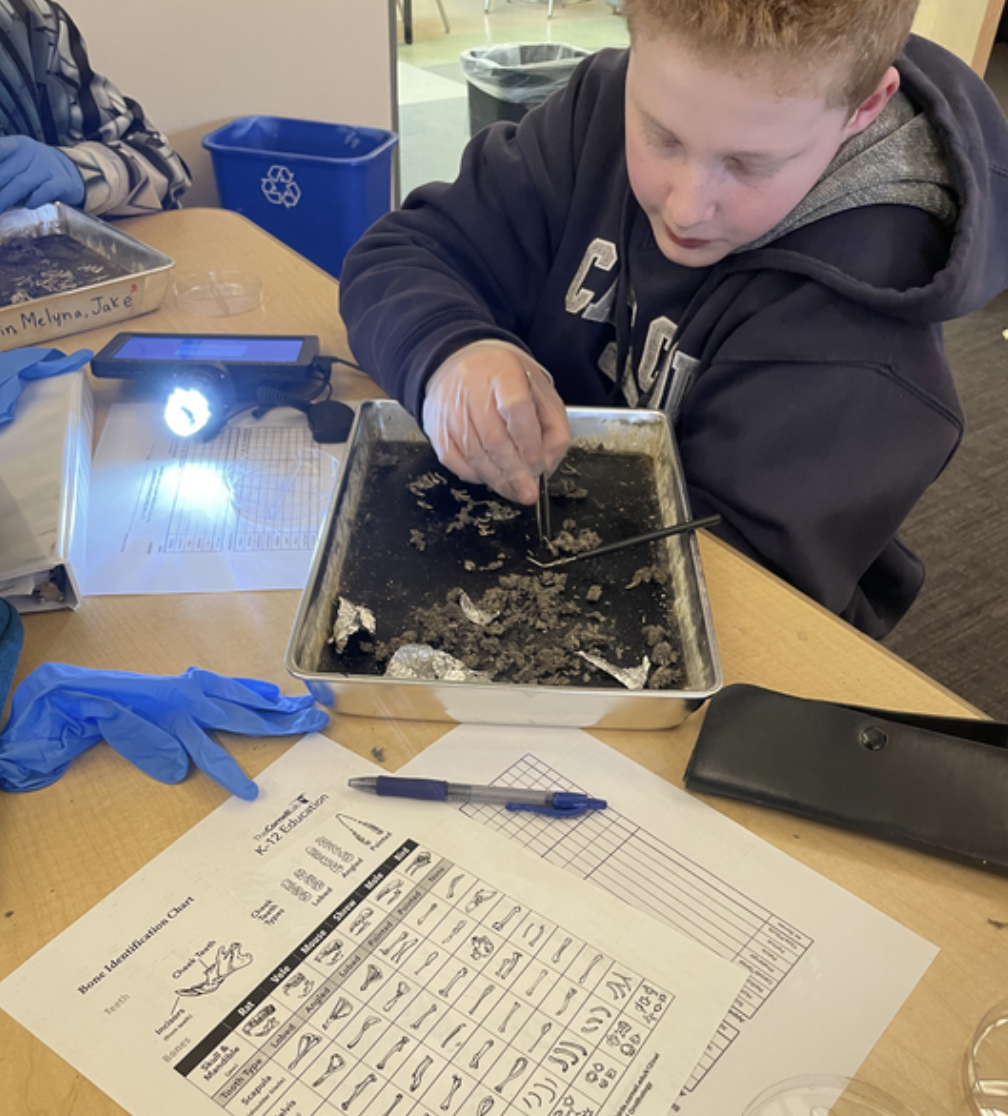
In Mr. Aaron’s Human Anatomy & Physiology course, students explore how the body’s systems interact to sustain life. Recently, the class completed a skeletal unit that moved well beyond memorizing bone names. Students examined the microscopic structure of bone tissue, analyzing how cellular architecture contributes to strength, flexibility, and joint function.
They asked questions like:
- How does bone structure enable movement?
- How do diet and nutrition influence skeletal health?
- How does the body regulate calcium intake to maintain homeostasis?
By zooming between microscopic structures and whole-body systems, students regularly engage in Acera’s core capacities such as systems thinking, recognizing that biological function emerges from interaction.
Physics: Optics
In Ms. Alexis’s Physics class, students recently completed a design challenge centered on optics. Using five light sources, mirrors, and lenses, they were tasked with engineering a working spotlight for a stage.
This project required:
- Understanding how light reflects and refracts
- Applying geometric reasoning
- Iterating through trial and error
- Balancing theoretical understanding with practical constraints
Physics becomes tangible when students must design, test, revise, and defend their solutions. The spotlight is not just a product — it is the visible result of abstract principles brought to life.
Astronomy: Modeling the Motion of the Universe
In Ms. Alison’s Astronomy course, students are exploring the physics of orbits. They are preparing to conduct a lab modeling gravitational force and orbital motion, examining how mass and distance influence celestial paths.
Rather than memorizing Kepler’s Laws, students grapple with the deeper questions:
- Why do orbits look the way they do?
- How does gravity shape structure across the universe?
- What mathematical relationships govern motion?
Astronomy at Acera blends wonder with rigor. Students confront the elegance of physical law while building quantitative models that make that elegance visible.
The Philosophy Behind It All
Across all Upper School Science courses, several themes unite the work:
- Choice and ownership: Students engage deeply when they have agency.
- Real-world application: Science is most powerful when it connects to lived experience.
- Systems thinking: Whether studying bones, enzymes, optics, or orbits, students learn to see interconnection.
- Argument from evidence: Claims must be supported, revised, and defended.
- Intellectual courage: Students are invited into complexity, not shielded from it.
We believe that developing scientific habits of mind prepares students not just for advanced coursework, but for life. The ability to analyze data, weigh evidence, revise thinking, and design solutions is transferable across disciplines and professions.
Most importantly, we aim to safeguard curiosity. In a world where information is abundant, what matters most is not memorizing facts, but knowing how to ask meaningful questions and pursue them with integrity.
Upper School Science at Acera is about cultivating thinkers, problem-solvers, designers, and investigators. It is about helping students see themselves as capable of engaging with complex systems — from the cells in their bodies to the forces that govern galaxies.
Related Posts