
By Dr. Heather J. Pinedo-Burns, Head of School There is a common misconception regarding gifted…
What Does Academic Challenge Actually Look Like at Acera?
By Emily Stefanich, Dean of Academics
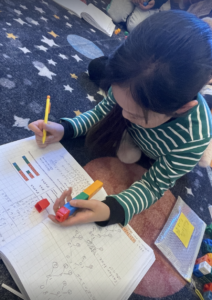 Ask most people what academic challenge looks like, and you'll get a familiar answer: harder worksheets, more homework, a grade skipped, a testaced. It's an understandable answer, and it's almost entirely about more.
At Acera, we think about challenge differently. For us, real challenge isn't about piling on. It's about fit — finding the exact place where a student's current ability meets a question, skill, or problem they haven't yet mastered. That's harder to deliver than "more." It requires knowing each child well, and a curriculum flexible enough to meet them there.
Acera's mission is to enable gifted learners to become their best selves, to learn based on ability and interest — not age, not grade level, not a pacing guide. We exist, in part, to safeguard children's innate curiosity, and real challenge is central to that. It teaches what ease can't: that effort, struggle, and even failure are part of how genuine thinking happens.
That starts with how we treat standards. State standards and grade-level benchmarks tell us the minimum a student should know by a certain point - in other words: the floor, not the ceiling. For many of our students, it's a floor they crossed a while ago. So instead of asking whether a student has met the benchmark and stopping there, we ask a more interesting question: now that they have, what's next for this student, specifically? You can see that thinking most clearly in our ability-based math programming, where a sixth grader might work through Algebra I or Advanced Geometry — not to push kids ahead for its own sake, but because it's genuinely the right level, one they find energizing rather than overwhelming.
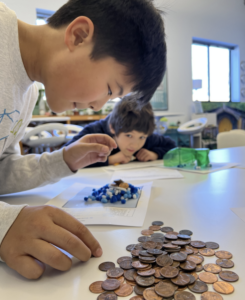
Getting that fit right, subject by subject and student by student, is what differentiation actually means at Acera. It isn't an occasional accommodation; it's a daily, structural habit. Teachers adjust the depth of a topic, the pace a student moves through it, the complexity of the questions asked, and the support a student receives — sometimes all four in the same lesson. Two students might explore the same unit at very different levels of abstraction. One student might move through a sequence faster than a peer without ever leaving their community. A task might be built with several valid entry points rather than one correct level of difficulty. The result is a classroom that rarely looks like one lesson delivered the same way to everyone. It looks more like a dozen parallel conversations, all circling the same core idea from different altitudes.
That same instinct shows up everywhere, not just in math. It's there in science, when a student in kindergarten or first grade doesn't just read about Newton's laws but builds a marble run, watches it fail, adjusts it, and arrives at the physics through their own iteration. It's there in writing, when an upper school student takes on the real work of synthesizing research and has to distill it into something coherent enough for an actual audience, such as a proposal for a paper at a student-led academic conference. And it's there in the humanities, in electives like History of Financial Speculation or The Rhetoric of Documentary Films, where students are trusted with genuinely difficult ideas, asked to blend disciplines, and expected to construct their own understanding rather than receive a settled one.
None of this is improvised, rather it reflects established best practice in gifted education, most visible in the interest-driven, project-based learning at the heart of our Inquiry, Maker, Passion Projects program, where a student's niche curiosity — an obscure question, an offbeat interest — can grow into real work with a real audience.
That same body of research also reminds us that challenge can't just be academic. Gifted children don't always develop evenly — a student capable of remarkably sophisticated abstract thinking may still need real support with organization, emotional regulation, or friendship. So when we talk about finding the right fit for a child, we mean the whole child, not just the part of them that's ready to move fast.
Put all of this together, and a picture starts to form of what challenge actually means at Acera. It isn't about how fast a student moves or how far ahead they get. It's about whether a student is regularly encountering ideas and problems that ask something real of them, and whether they have the support, relationships, and resilience to meet that challenge and grow from it. That's the kind of challenge we think every gifted learner deserves — and the kind of fit we build the whole school around.